
Commercial Property Loan Guide for Australian Businesses
The lowest advertised rate may not be the right commercial property loan for your business. The property’s purpose, how you plan to use it and the repayments your cash flow can comfortably support all matter when choosing a finance structure.
Commercial lending can feel complex because lenders may consider both your business finances and the property. Start by looking beyond the headline rate and asking how the loan’s repayments, terms and flexibility fit your plans over time.
This guide explains common commercial property loan structures and their trade-offs, what lenders may assess, and how to plan repayments alongside your business’s cash flow. You’ll also see how property use, income and your financial position can shape an assessment. Genesis Financial Services arranges commercial property finance and provides personalised guidance through the process, from application to settlement, helping you explore a borrowing approach with greater clarity.
Table of Contents
What Is a Commercial Property Loan, and What Can It Help Your Business Do?
Commercial Property Loan Structures: Match the Finance to the Property Plan
Compare Commercial Property Loan Options Without Focusing on One Feature
Can Your Business Manage a Commercial Property Loan? Understand the Assessment
From Property Plan to Settlement: Explore a Commercial Property Loan with Guidance
What Is a Commercial Property Loan, and What Can It Help Your Business Do?
A commercial property loan is finance used to purchase or refinance property for business or investment purposes in Australia. The suitable structure depends on how you’ll use the property, its characteristics and your circumstances. A business buying premises for its own operations has a different purpose from an investor buying a property to earn rental income, so one loan structure won’t suit every situation.
Commercial property finance can support a business goal, but it also creates a borrowing commitment that needs to fit your wider plan. Start by defining the property’s role: will it house your business, generate rent or form part of a development project? That purpose helps frame the finance discussion. For additional background on how commercial mortgages may be structured, see this Commercial Mortgage Overview.
When might a business use a commercial property loan?
A business might seek finance to buy premises where it can operate, such as an office, warehouse or retail space. Owning the property can give the business control over its location and premises, while the loan adds repayments and other property obligations to its financial commitments. An investor, by contrast, may buy commercial premises to earn rental income. These different uses can affect how the borrowing is assessed and structured.
Refinancing is another possible purpose. A business may review existing property finance when its circumstances or objectives change. Refinancing isn’t automatically a better option, so consider the new arrangement as a whole, including its obligations and fit with your plans.
Buying an existing property is different from funding a development. A purchase involves finance to acquire a property that already exists, while a development project involves funding work to create or substantially develop property. Commercial property development finance is a distinct option, and the project details and borrower’s circumstances help shape the approach.
How does commercial property finance differ from a home loan?
A home loan is generally connected to residential property, while commercial-purpose lending considers the property’s business or investment use and the borrower’s business context. That can mean looking at the business behind the application as well as the property itself. The purpose matters: premises used by a business and a property intended to earn rent don’t necessarily present the same circumstances.
There isn’t one assessment or set of loan terms for every commercial application. Lenders can differ in how they assess a borrower and property, and applications can have different features. Residential lending rules and assumptions therefore shouldn’t be treated as automatic guides to commercial finance. A broker can clarify the property goal, arrange finance suited to the application and guide you through the process from application to settlement.
Commercial Property Loan Structures: Match the Finance to the Property Plan
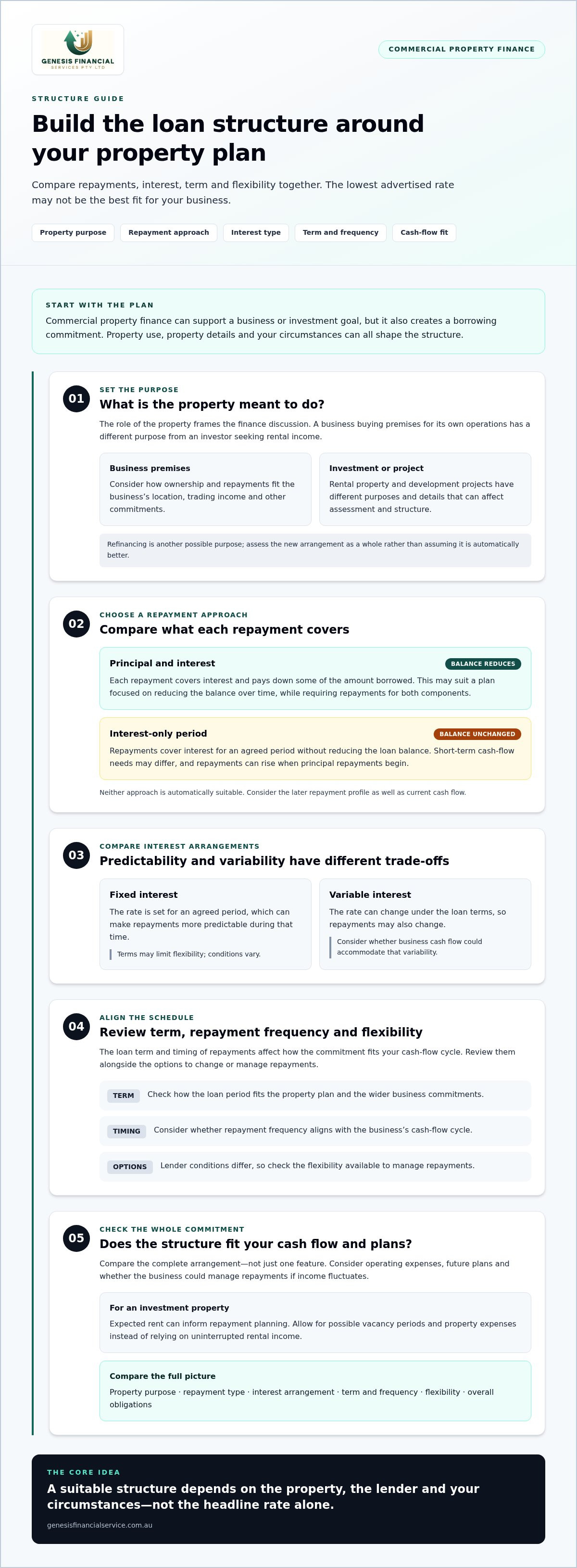
Once you know the property’s purpose, consider how repayments and interest arrangements fit your business plans. Commercial property loans can have different features, and their availability and suitability depend on the lender, property and your circumstances. Compare the whole arrangement, not just one feature. In particular, consider how repayments could sit alongside operating expenses and future plans.
Here’s a high-level comparison of features to discuss:
Principal-and-interest repayments: Each repayment covers interest and pays down some of the amount borrowed. This may support a plan to reduce the balance over time, but repayments include both components.
Interest-only period: Repayments cover interest for an agreed period without reducing the loan balance during that time. This may change short-term cash-flow needs, but repayments can rise when principal repayments begin.
Fixed interest: The interest rate is set for an agreed period, which can make repayments more predictable during that time. Terms may limit flexibility, and conditions vary.
Variable interest: The rate can change under the loan terms, so repayments may also change. Consider whether your cash flow could accommodate that variability.
Term and repayment frequency: The loan term and timing of repayments affect how the commitment fits your cash-flow cycle. Review these alongside any flexibility to change or manage repayments, as lender conditions differ.
Which repayment structure could suit an owner-occupied property?
If your business plans to operate from the premises over the longer term, consider how repayments align with expected trading income, planned investment and other commitments. Principal-and-interest repayments may fit an ownership plan focused on paying down the balance, while an interest-only period has a different short-term repayment profile. Neither is automatically suitable. Check how repayments could change later and whether the business could manage them if income fluctuates.
How can investment-property plans affect loan structure?
For an investment property, expected rent can inform repayment planning. Allow for possible vacancy periods and property expenses rather than relying on uninterrupted rental income. Lenders may assess rental income, expenses and property details differently, so the same property plan can be considered differently across applications. Keep borrowing decisions separate from tax assumptions, and seek advice from a qualified tax professional about your circumstances.
The Australian Government’s Property Management Framework applies to Commonwealth property, not commercial loan terms. It provides context on considering acquisition and ongoing property management together, a useful reminder to think beyond the purchase itself.
A broker conversation can help you map loan features against your ownership or investment plans. Discuss your commercial property finance options with Genesis Financial Services, which arranges finance and provides guidance through the process.
Compare Commercial Property Loan Options Without Focusing on One Feature
An advertised rate is an easy starting point for comparison, but it doesn’t show whether a loan fits your property plans or reveal all its costs and conditions. A more useful comparison starts with the purchase purpose, then considers what your business can comfortably repay and what flexibility it may need over time.
Loan suitability depends on the borrower, property, security and repayment plan. Use that as a practical lens when reviewing options. For each proposal, consider:
Property purpose: Is the property for your business to occupy, to earn rental income or to support another plan?
Borrower capacity: How do existing commitments, income and expected business cash flow affect your ability to meet repayments?
Loan features: Do the repayment structure, term and available flexibility work with your plans?
Overall obligations: What fees, charges, security requirements and other conditions apply?
This framework helps you compare like with like. A lower advertised rate may come with conditions or repayment features that don’t suit your needs. Another option may align better with your plans, but you still need to review its overall obligations carefully.
What should you compare beyond the interest rate?
Read the proposed terms as a whole. Review fees and charges, repayment frequency, whether repayments may change, and what flexibility is available if your business circumstances shift. Consider the security required and conditions attached to using or refinancing the property. These details vary by lender and application, so don’t assume a feature available in one proposal will apply to another.
Lenders may also assess applications differently, taking account of the property, security, borrower’s financial position and intended use. A useful comparison shows not only the rate, but also the obligations and features that matter to your business. Have any unclear terms explained before making a decision.
How do property purpose and ownership affect the comparison?
Business premises and investment property serve different purposes. A business occupying its premises may focus on how repayments fit alongside trading expenses and longer-term operating plans. An investor may also need to consider rental income, expenses and periods without a tenant. These differences can influence the information lenders consider and the loan terms that are relevant.
The way a property is owned may also affect an application. If a company, trust or other ownership arrangement is involved, consider getting appropriate legal, accounting or tax advice about the structure and its implications. A lender’s assessment is specific to the application, so don’t assume the same terms or eligibility apply across ownership arrangements.
For a project involving construction or development, treat the funding needs as distinct from borrowing to purchase an existing property. Review a development-specific finance guide as a separate step in your research, then compare options against the project plan and its obligations.
Can Your Business Manage a Commercial Property Loan? Understand the Assessment
A lender’s assessment looks beyond the property offered as security. The property may secure the borrowing, but that doesn’t remove the need to consider whether your business can manage repayments. Thinking through both elements early can give you a clearer view of the commitment involved in a commercial property loan.
Assessment commonly considers how the borrower’s financial position and the property fit together. A lender may look at:
Repayment capacity: whether available income can support repayments alongside other commitments.
Business income and performance: the nature and consistency of income, considered in the context of the business.
Liabilities: existing loans and other financial obligations that affect cash flow.
Security and property details: the proposed security and characteristics of the property being financed.
Security matters, but it isn’t a substitute for repayment capacity. A property’s value alone doesn’t show whether repayments are manageable for the business. Lender criteria vary by lender and application, and approval is never guaranteed.
How can you think about repayments alongside business cash flow?
Start with cash flow the business can reasonably rely on, not just its most optimistic income forecast. Compare likely repayments with operating costs, existing commitments and planned spending. Then consider less favourable scenarios, such as a quieter trading period, delayed customer payments, a vacancy if the property is tenanted, or rising expenses. This can help show whether there’s room to meet repayments without putting day-to-day operations under avoidable pressure.
Expected income and dependable cash flow aren’t always the same. Projected rent may contribute to a plan, for example, but a gap between tenants could interrupt that income. A borrowing calculator can illustrate possible repayments, but it can’t account for every lender’s criteria or guarantee approval. Treat any estimate as one planning input, not a lending decision.
What do lenders generally consider about the borrower and property?
Lenders may consider business performance, income, liabilities and proposed security alongside details of the property. The property’s type, location, condition and intended use can inform how it is viewed. A valuation may also form part of the assessment, but the approach and outcome can differ according to the property, lender and application.
These factors work together. The same property could be part of applications with different borrower finances, commitments or business plans, leading to different assessments. Focus on the full picture rather than assuming a particular property value will determine the outcome. Detailed paperwork is best handled separately as part of preparing a commercial property loan application.
If you’d like support understanding how your business position and property plans may fit together, discuss your commercial property finance options with Genesis Financial Services. The team arranges finance and guides clients through the process from application to settlement.
From Property Plan to Settlement: Explore a Commercial Property Loan with Guidance
Turning a property goal into a finance plan can feel easier when you know what happens next. A broker can help clarify what the property needs to do for your business, consider suitable finance pathways and guide you through the application process. The lender, not the broker, assesses the application and makes the lending decision, so approval can’t be promised.
A typical pathway may include these stages:
Clarify the property goal. Identify whether you’re buying premises for your business, purchasing an investment property, refinancing or planning a development. Consider your intended timing and what you need the property to support.
Review the finance approach. Discuss your business context, priorities and repayment plans. A broker can help you understand relevant loan options and how their features may fit your circumstances.
Prepare and submit an application. Once you decide how to proceed, the broker can guide you through the application process and coordinate the information required for the lender’s assessment.
Proceed towards settlement. If the lender approves the application and any relevant conditions are met, the process can move towards settlement. The steps and timing depend on the application and lender.
What happens when you explore finance with a broker?
The first conversation is a chance to explain the property’s purpose, your business context and what matters most to you, such as repayment fit or flexibility. A broker can then help you consider finance options and guide you through the application process. The lender reviews the application against its own criteria and makes the decision. This distinction helps set clear expectations from the outset.
It helps to bring a clear outline of your plan: what you want the property to enable, how you expect to use it and what repayment level feels manageable alongside business commitments. You don’t need to have every question settled before starting a conversation. Clarifying your priorities can make the next steps easier to understand and keep the finance discussion focused on your goals.
How can you take the next step with Genesis Financial Services?
Genesis Financial Services is an Australian credit broker based in Mickleham, Victoria, serving clients nationally. The team arranges commercial property finance rather than lending directly, and provides personalised guidance from application to settlement. That support can help you understand the process, weigh relevant options and prepare for what the lender will assess, without assuming an outcome in advance.
If you’re considering a purchase, refinance or development, start by talking through the property plan and the priorities behind it. Talk through your commercial property finance plans with Genesis Financial Services when you’re ready to explore the next step.
Make Your Next Property Decision with Clarity
Before moving ahead, define what a suitable outcome would look like. Consider which commitments your business can manage, what flexibility matters if circumstances change, and what questions you need answered before deciding. That preparation can help keep a commercial property loan aligned with your business priorities, rather than letting the process set the pace for you.
Genesis Financial Services operates as a credit representative authorised under Australian Credit Licence 389328. With personalised guidance through the finance process, you can talk through your property plans and consider a way forward without assuming approval or rushing into a commitment.
Talk through your commercial property finance plans with Genesis Financial Services when you’re ready to take the next step. A clear conversation can help you move forward with a plan that fits your business priorities.
Frequently Asked Questions
How much deposit do you need for a commercial property loan in Australia?
There’s no single deposit requirement for every commercial property purchase. As a general guide, research available for this article indicates major bank lenders commonly cap commercial property lending at around 65% to 70% of the property value, which may mean contributing roughly 30% to 35% as a deposit. Some lenders may consider higher lending levels, but the property, security and borrower’s circumstances affect the assessment. Allow for other purchase costs as well.
Can a business use a commercial property loan to buy its own premises?
Yes. A business may use commercial finance to purchase premises it will occupy, such as a warehouse, office or shop. For example, a business renting its current workshop might consider buying a suitable site to support its operations. The lender will assess the proposed property and the business’s ability to meet repayments. Consider how ownership could affect working capital and plans to relocate or expand before committing.
Can you get a commercial property loan through a company or trust?
It may be possible to apply through a company or trust, but the ownership structure can affect how a lender assesses the application. The lender may consider the entity’s financial position, the people involved and the proposed security. Before choosing or changing a structure, get advice from a qualified accountant or lawyer about legal, tax and reporting implications. Don’t assume a structure used for another loan will suit this purchase.
What happens if a business cannot meet commercial property loan repayments?
If repayment difficulties arise, contact the lender as early as possible and explain the business’s circumstances. Ask what options may be available and review the loan agreement to understand the relevant terms and consequences. If payments are missed, the lender may take steps set out in that agreement, which could put the property security at risk. Consider getting independent legal or accounting advice if you’re unsure how to respond.
Are commercial property loan interest rates fixed or variable?
Commercial property finance may offer fixed or variable interest options, depending on the lender and application. A fixed rate can provide more certainty about interest costs during the agreed period, while a variable rate may change under the loan terms. Compare how each option affects repayments, flexibility and the business’s plans. Have the full conditions explained, including what happens when a fixed-rate period ends.
How long does a commercial property loan application take?
There’s no standard timeframe for every application. Timing can depend on how quickly information is provided, whether the lender needs a property valuation, the complexity of the borrower’s circumstances and the lender’s assessment process. A straightforward purchase may involve different steps from a refinance with multiple securities or ownership entities. Build flexibility into your transaction planning, and avoid relying on settlement timing until the lender confirms its requirements.
Is a commercial property loan the same as a development loan?
No. A commercial property loan commonly finances the purchase or refinance of an existing property, while a development loan is intended for a project involving construction or development. The assessment for development finance may need to consider project details such as costs, stages and progress, as well as the borrower and security. If your plan includes building or substantial redevelopment, describe the project clearly when exploring finance options.

Comments