
Unsecured Business Loans Australia: Compare Your Options in 2026
The loan that asks for less security may not be the one that puts the least pressure on your business. If you’re weighing unsecured business loans australia against secured finance, the right fit depends on more than whether you need to offer property or other assets as security.
It’s understandable to focus on security requirements when you want to protect business assets and keep cash flow steady. But loan structure, repayment frequency, fees and your ability to meet repayments matter too. An unsecured loan may avoid using a specific asset as security, while secured finance has a different structure. Lender criteria and any guarantees can vary, so understand the details before deciding.
This guide explains how unsecured business loans work in Australia and compares them with secured options. You’ll learn what to weigh against your funding purpose, cash flow and repayment capacity, and what information to prepare when exploring finance. Genesis Financial Services arranges business finance and provides personalised guidance through the application and settlement process.
Table of Contents
Unsecured Business Loans in Australia: How They Work
An unsecured business loan is finance that doesn’t rely on specified business assets as security for the loan. It can fund business needs without tying the borrowing to a particular asset, but it still comes with contractual repayment obligations, fees and other terms. You’re responsible for meeting those obligations even if the loan isn’t secured against business property or equipment.
What does “unsecured” mean for an Australian business borrower?
“Unsecured” describes the loan’s security arrangement, not whether you have to repay it. With a secured loan, a lender may rely on specified assets as security. For an unsecured loan, the arrangement isn’t based on specified business assets, but the loan remains a binding commitment. If repayments are missed, the lender may take action in line with the contract and applicable requirements.
Unsecured doesn’t automatically mean that no personal guarantee is required. A lender may ask for one, depending on its criteria and your business’s circumstances. Eligibility requirements, documentation, repayment schedules and other terms also vary. The label alone won’t tell you what a particular offer involves. Read the full terms, including any guarantees and the consequences of falling behind on repayments.
For businesses comparing unsecured business loans australia, start by asking what assets, if any, secure the borrowing and what other commitments the agreement creates. Don’t assume “unsecured” means risk-free or that personal and business obligations are identical across different loan arrangements.
What business needs might unsecured finance support?
Depending on the lender’s permitted uses and the loan structure, unsecured finance may help address a temporary cash-flow gap, cover working capital needs or fund planned business expenditure. A business waiting for customer payments, for example, might need funds to manage operating expenses in the meantime. Another business may be planning expenditure to support its operations or growth.
The purpose matters because the loan structure should fit how and when you expect to use the funds and repay them. A short-term timing gap calls for a different assessment from a longer-term investment. Consider whether expected cash inflows can support repayments alongside wages, supplier invoices, tax and other commitments. If repayments depend on uncertain future income, borrowing could add strain rather than ease it.
Before applying, write down the funding purpose, when the expense is due and where repayments will come from. Compare those needs with the lender’s permitted uses, repayment schedule and other terms. This helps you judge whether the finance addresses a practical need without placing avoidable pressure on cash flow. For a broader view, compare unsecured borrowing with business finance options such as cash-flow finance, working capital loans and secured business loans.
How lenders assess unsecured business loan applications
Without specified business assets as loan security, a lender may look closely at the business’s performance and its ability to manage the proposed repayments. The assessment isn’t based on one number alone. Lenders may consider business performance, cash flow, trading history, existing commitments, the requested amount and repayment schedule. Criteria differ, and no single factor guarantees approval.
For businesses exploring unsecured business loans australia, present a clear picture of your current finances and the reason for borrowing. A request that matches the business’s needs and likely repayment capacity is more useful to assess than one based only on the maximum amount available.
Which business information may lenders consider?
Depending on the lender and application, supporting information may include financial statements, business bank activity, tax information and details of existing liabilities. Documentation requirements vary. Clear, consistent records help explain how money moves through the business and provide context for changes in income or expenses.
Before applying, organise the information you have and check that figures are consistent across records. If revenue varies by season or a major expense has affected recent results, a concise explanation can clarify the business’s position. Don’t assume one document will be enough for every application.
Do unsecured loans require a personal guarantee?
Some unsecured loan terms may include a personal guarantee, even when the loan doesn’t rely on specified business assets as security. Whether a guarantee applies depends on the lender’s requirements and the contract. It can create obligations for the person who gives it, so review its scope, conditions and implications before signing. If anything is unclear, seek independent advice about the contract.
Give repayment capacity particular attention. Consider how the proposed repayments fit alongside regular expenses, existing debt commitments and changes in cash flow. A business with uneven customer receipts, for example, should assess whether repayments remain manageable during quieter periods, not only in a strong month. Set the requested amount and schedule against realistic incoming cash rather than optimistic projections.
Map expected income and essential outgoings across the repayment period, then consider what would happen if a customer paid late or costs rose. This can reveal pressure points before you take on another commitment. The lender’s assessment and decision will depend on its criteria and the details of your application.
If you’d value support comparing finance options against your business circumstances, speak with Genesis Financial Services. Genesis arranges finance rather than lending directly and provides personalised guidance through the application-to-settlement process.
Unsecured vs secured business loans: compare the trade-offs
The central difference is whether specified assets support the borrowing, but the practical choice involves more than collateral. An unsecured loan may avoid tying the borrowing to a particular business asset, while a secured loan uses agreed security. Neither structure is automatically faster, cheaper or easier to obtain. Lender criteria and contract terms matter, as do your assets and the cash flow available to meet repayments.
When might unsecured finance be worth comparing?
Unsecured finance may be worth exploring if you want to avoid offering a particular business asset as security, or if tying up an asset doesn’t suit your plans. That preference alone doesn’t determine whether a loan is suitable. Lender assessment still applies, and repayments need to fit the business’s actual cash flow.
Test affordability using realistic assumptions. Include regular expenses, existing commitments and periods when customer receipts may be lower or delayed. If repayments would leave little room for those fluctuations, the structure could put pressure on day-to-day operations. For businesses comparing unsecured business loans australia, the absence of specified asset security is one factor to weigh, not a guarantee of a better fit.
When might secured finance be a better fit?
If your business has suitable assets and is comfortable offering them as security, compare secured options too. Security can affect how a lender assesses an application and the terms it offers, but it doesn’t promise approval or a particular outcome. Weigh any potential benefits against the obligations and consequences set out in the agreement.
Compare the complete offer, not just the security requirement. Look at repayment frequency, total commitments, fees and any guarantees. Then consider how the arrangement fits your business purpose and cash-flow resilience. A sound comparison reflects what the business can manage and the obligations it accepts, rather than assuming one loan type is always preferable.
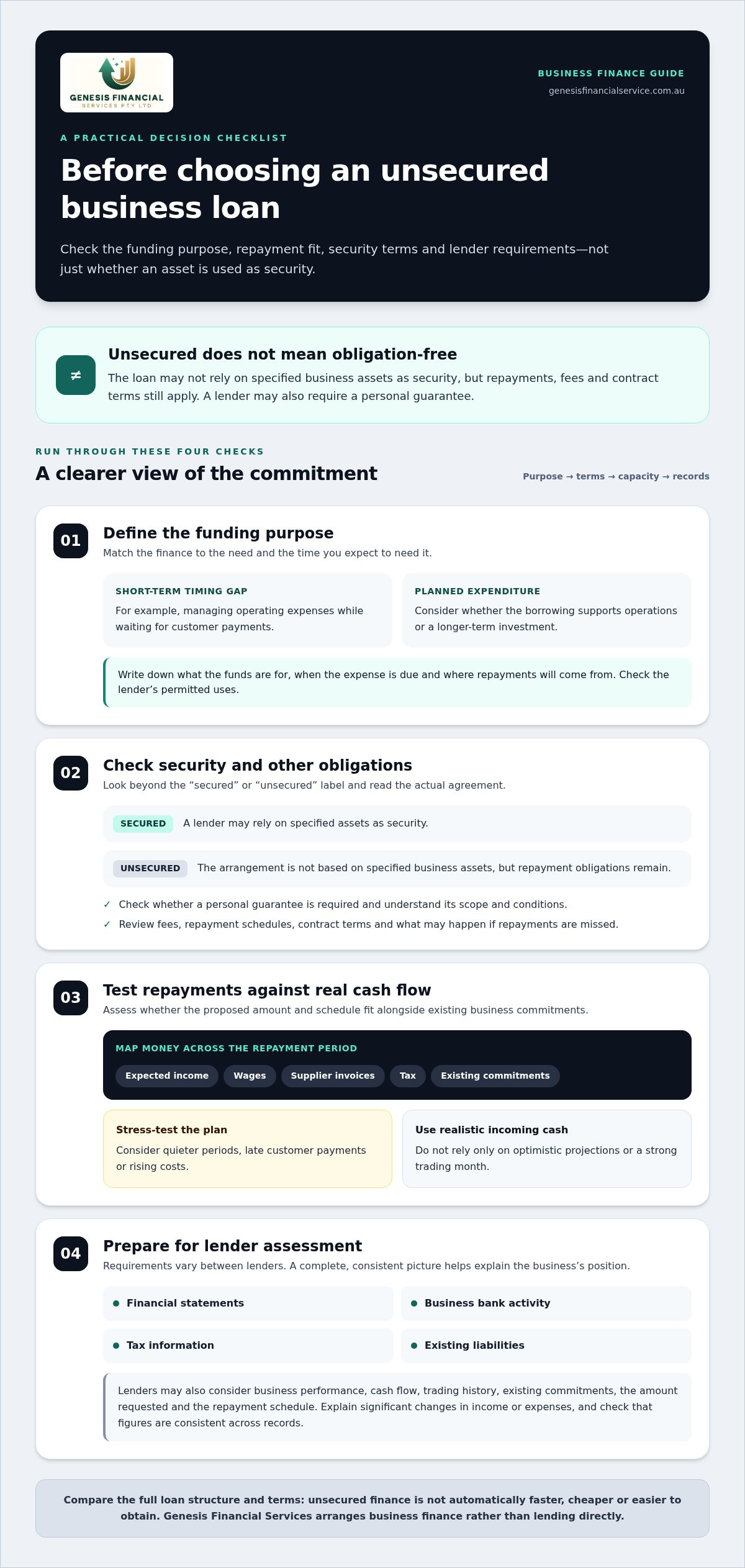
How to decide whether an unsecured business loan fits your plans
A loan is more useful when its purpose, repayment structure and business cash flow align. Before choosing unsecured finance, work through these steps to clarify what you need and what your business can reasonably manage.
Define the purpose. Identify the expense and when funds are needed. A short-term cash-flow gap, such as a mismatch between supplier bills and customer receipts, differs from a longer-term investment in equipment or business growth. Match the finance structure to the need and the expected timing of its benefit.
Test repayment capacity. Estimate repayments against cautious cash-flow expectations, not just a best-case sales forecast. Include current debts, operating costs and a buffer for late payments, quieter trading periods or unexpected expenses.
Compare structures. Consider unsecured and secured finance alongside other relevant business finance options. Weigh security arrangements and repayment commitments against your funding purpose, available assets and willingness to offer them as security.
Review the terms. Compare the full repayment obligation, lender-stated fees, loan term and repayment frequency. Read the conditions carefully, including any guarantees, default provisions, early repayment terms and circumstances in which repayments can change.
How can a business test repayment capacity?
Build a simple cash-flow forecast across the proposed repayment period. Use cautious income estimates, then subtract operating expenses, existing loan repayments, tax and other known commitments. Consider what happens if a key customer pays late or revenue drops for a period. The aim is to see whether repayments remain manageable under realistic conditions, not only during a strong trading month.
If your cash flow is complex or seasonal, an accountant can help model different scenarios and identify where a new commitment could create pressure. Their input can support a more informed borrowing decision, but it doesn’t replace reviewing the lender’s offer and your ability to meet its terms.
What should you compare before proceeding?
Look beyond the headline repayment. Compare total obligations over the term, any fees stated by the lender, repayment frequency and the length of the commitment. A schedule that appears manageable in isolation may be harder to sustain alongside existing debts or uneven business income.
Check the contract and disclosure documents for conditions about personal guarantees, missed repayments, early repayment and changes to repayments. These documents set out the actual obligations, so make sure you understand them before signing. If a clause is unclear, consider appropriate independent advice rather than relying on assumptions.
Once you’ve mapped the purpose, repayment capacity and terms, you’ll have a clearer basis for comparing unsecured business loans australia with other finance options. To discuss finance structures in light of your business circumstances, speak with Genesis Financial Services. Genesis arranges finance rather than lending directly and provides personalised guidance through the application-to-settlement process.
Compare unsecured business loan options with Genesis Financial Services
After considering your funding purpose, cash-flow capacity and the terms that matter to your business, it can help to talk through the options with a finance broker. Genesis Financial Services arranges unsecured and secured business finance, as well as cash-flow and working-capital options. Genesis isn’t the direct lender. The team provides personalised guidance to help you compare finance pathways against your circumstances and understand the steps involved.
Genesis Financial Services serves businesses across Australia from Mickleham, Victoria. Genesis Financial Services Pty Ltd operates as a credit representative authorised under Australian Credit Licence 389328. Lender criteria, documentation and decisions depend on the finance option and your circumstances, so compare your needs with the relevant requirements.
How can a finance broker support the comparison?
A broker can help clarify what you’re funding, how much time the business has to repay and whether unsecured or secured finance aligns with your plans. This can bring practical differences into focus, including security arrangements, repayment structures and the information a lender may need to assess an application.
Support can also include preparing an application and communicating through the process to settlement. A broker can help you understand the steps and compare suitable pathways, but can’t promise that a particular lender will approve an application or that a specific outcome will be available.
What happens when you discuss your business finance needs?
Start with a clear account of your business and its current position. Be ready to explain the funding purpose, when you need the funds, how the business expects to use them and what repayment level appears manageable. It may also help to outline existing commitments and seasonal or variable cash-flow patterns that affect repayment capacity.
The next steps depend on your circumstances and the relevant lender’s requirements. You may need to provide supporting business information, and the lender will assess the application under its own criteria. Review any proposed terms, including repayment obligations, fees, guarantees and other conditions, before deciding whether to proceed.
If you’re weighing unsecured business loans australia against secured or cash-flow finance, a considered discussion can help you organise questions and compare options in context. Share your business purpose and repayment expectations with the Genesis Financial Services team to discuss your finance needs.
Turn your finance comparison into a considered next step
Put your funding purpose, preferred timing and realistic repayment capacity into a short brief. This gives you a practical starting point for a conversation and keeps the focus on what your business needs, rather than on a loan label alone. If you’re considering unsecured business loans australia, use the brief to discuss both your preferred structure and the commitments your business can comfortably manage.
Genesis Financial Services arranges finance rather than lending directly, and supports clients through the application-to-settlement process. The business serves clients nationally from Mickleham, Victoria. Genesis Financial Services Pty Ltd operates as a credit representative authorised under Australian Credit Licence 389328.
A conversation doesn’t commit you to a particular option. It’s an opportunity to discuss your circumstances and consider a suitable way forward with guidance through the process.
Discuss your business finance options and take the next step with greater clarity.
Frequently Asked Questions
Is an unsecured business loan really unsecured?
It can be unsecured in relation to specified business assets, but that doesn’t make the borrowing free of conditions or repayment obligations. Some agreements may include a personal guarantee or other commitments. A business owner, for example, may be asked to guarantee repayment even if no particular company asset secures the loan. Check who is responsible, what triggers default and what the lender can do if repayments aren’t made.
Can a new business get an unsecured business loan in Australia?
It may be possible, although a short trading history can affect how a lender assesses the application. A newer business can organise the records it has, such as recent bank activity, financial forecasts and evidence supporting the proposed use of funds. Lender criteria differ, and no single document or business characteristic guarantees approval. A finance broker can help you understand what information may be relevant to your circumstances.
Do unsecured business loans require a personal guarantee?
Some do, depending on the lender and the specific agreement. A personal guarantee is distinct from offering a particular business asset as security, so check the guarantee provisions separately. Before signing, identify who is giving the guarantee, what obligations it covers and when the lender may rely on it. If you’re unsure about the legal effect of a clause, consider independent legal advice before proceeding.
How much can an Australian business borrow without security?
There’s no standard borrowing amount that applies to every lender or business. The amount considered may depend on the business’s financial position, trading record, existing commitments and intended use of funds. For unsecured business loans australia, don’t treat an advertised maximum as a suitable target. Estimate what repayments the business could manage if income fell or an expected customer payment arrived late.
How quickly can an unsecured business loan be approved?
Approval timing varies with the lender, the application and whether further information is needed. An application with incomplete records, for example, may take longer if the lender needs clarification about revenue or existing debts. An advertised timeframe isn’t a promise for an individual application. Organising accurate, current business information can help avoid preventable follow-up, but it won’t determine the lender’s decision or timing.
Can I use an unsecured business loan to pay an ATO tax debt?
Whether a loan can be used for an ATO tax debt depends on the lender’s terms and your circumstances. Compare the repayment commitment with the tax liability and other upcoming obligations, rather than focusing only on clearing the immediate amount. Genesis Financial Services arranges ATO Tax Debt Loans as well as other business finance options. Consider qualified tax advice to understand the implications for your business.
Does applying for an unsecured business loan affect my credit file?
A lender may make a credit enquiry during its assessment, but how an enquiry is handled and whether it affects your credit file depends on the lender and your circumstances. Before submitting applications to several lenders, review how each handles enquiries and read the relevant application and privacy information. This helps you understand what information may be collected and avoids assuming that every enquiry has the same effect.

Comments